
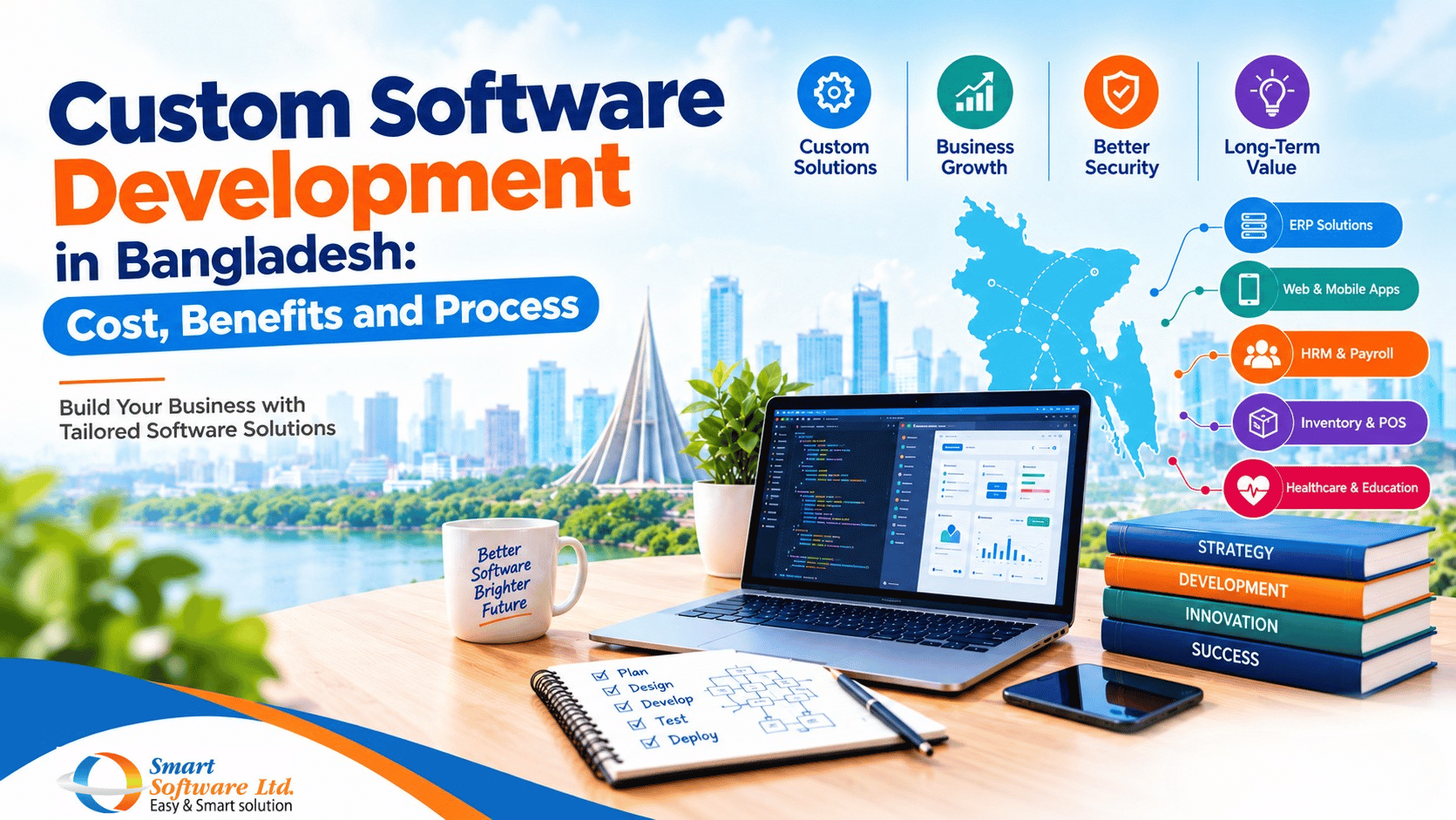
Custom Software Development in Bangladesh: Cost & Process
Every business has its own goals, daily challenges, and customer needs. Ready-made software can handle common tasks, but it doesn't always give a growing company the flexibility it needs. That's where custom software development comes in.
Across Bangladesh, businesses in manufacturing, retail, healthcare, education, e-commerce, and logistics are turning to software to work faster and keep operations organized. Custom software lets you build a digital system around the way your business already works, instead of bending your processes to fit a generic app.
So how much does custom software development cost in Bangladesh? What are the real benefits, and how does the process work from start to finish? This guide walks through all of it.
What Is Custom Software Development?
Custom software development means designing, building, testing, and maintaining software for the specific needs of one business or organization. Ready-made applications are built for a broad audience. Custom software is built to solve your particular problems, automate your workflows, and support your long-term growth.
A few examples show the difference:
- A manufacturing company may need production planning and costing and inventory tracking in a single system.
- A hospital may need patient management, appointment scheduling, billing, and reporting.
- A retail business may want sales, stock management, and accounting on one POS and retail management platform.
Common types of custom software include:
- Enterprise Resource Planning (ERP) software
- Customer Relationship Management (CRM) systems
- Human Resource Management (HRM) software
- Accounting and payroll software
- Inventory and warehouse management systems
- Hospital and school management software
- E-commerce platforms and web applications
- Custom mobile applications
- Business process automation systems
You decide which features, integrations, user permissions, and reports the system should include.
Custom Software Development Cost in Bangladesh
The cost depends on the project's complexity, the features you need, the technology used, the timeline, and the support you want after launch. A simple internal tool costs far less than a large enterprise platform with many modules, integrations, and security controls.
For early budget planning, the ranges below can serve as a rough guide. They are general estimates, not fixed prices or official Smart Software quotations.
| Project complexity | Indicative budget | Typical scope |
|---|---|---|
| Basic software | ৳1.5–4 lakh | Simple workflows, forms, and basic reports |
| Medium business application | ৳4–15 lakh | Multiple features, user roles, dashboards, and integrations |
| Advanced business software | ৳15–40 lakh | Complex workflows, multiple modules, and advanced reporting |
| Enterprise-level platform | ৳40 lakh+ | Large-scale systems, extensive integrations, and complex requirements |
Actual costs can fall outside these ranges depending on the scope, technical requirements, and service agreement.
Factors That Affect Software Development Costs
Knowing what drives the price helps you set a realistic budget and compare proposals fairly.
1. Project scope and features. The more features you add, and the more complex they are, the more development effort is needed. A basic inventory app with product records and stock updates is much simpler than a full inventory and supply chain platform.
2. UI and UX design. How people interact with the software matters. Custom dashboards, role-specific screens, responsive layouts, and accessibility requirements can add to the cost.
3. Technology stack. The programming languages, frameworks, databases, and infrastructure should fit your project and support performance, security, maintainability, and future expansion.
4. Third-party integrations. Connecting payment gateways, accounting systems, APIs, SMS services, or your existing business apps takes extra development time.
5. Data migration and security. Moving data out of spreadsheets or older software needs careful planning and validation. Systems that handle confidential business or customer information may also need stronger access controls, backups, and audit logs.
6. Maintenance and ongoing support. After launch, software usually needs hosting, monitoring, bug fixes, updates, security patches, and sometimes new features. Include these recurring costs in your total budget.
How to Keep Your Software Budget Under Control
A clear scope is the best way to manage cost. Before you start, identify the main business problem, list the essential features, define the user roles, and decide which integrations the first release really needs.
You can also start with a Minimum Viable Product (MVP), a working version with only the most important features, and add more based on real user feedback. And always ask for a detailed proposal that covers deliverables, timeline, payment terms, testing, deployment, documentation, and post-launch support.
Key Benefits of Custom Software Development
Custom software isn't the right choice for every business. But when ready-made tools can't support your workflows or long-term goals, it offers real advantages.
1. Software Tailored to Your Business
Every organization has its own processes, reporting needs, and priorities. With custom software, you skip the unnecessary features and clumsy workarounds and get a system that matches your day-to-day work.
2. Better Operational Efficiency
Manual processes, duplicate data entry, and scattered spreadsheets eat up time. Custom software can automate suitable workflows and make information easier to find. For example, an integrated system can link sales transactions with inventory records and accounting reports, so nobody has to update three separate places.
3. Stronger Data Management and Reporting
Good decisions need accurate, accessible data. Custom software can pull information from different parts of your operation into one platform. Depending on your needs, you can use dashboards, automated reports, activity logs, and performance indicators to see how the business is really doing.
4. Flexibility and Scalability
Your needs will change as you grow. A well-designed custom solution can take on new modules, users, integrations, and reports over time. How well it scales depends on the architecture and the quality of the implementation, so raise this early in the planning stage.
5. Integration With Existing Systems
Most businesses already use some combination of accounting tools, websites, payment systems, or inventory apps. Where it is technically feasible, custom development can connect them through APIs and other methods, which improves data consistency and cuts down on fragmented workflows.
6. Better Security and Access Control
Custom software can include role-based permissions, authentication, audit trails, and backups based on your requirements. That said, custom does not automatically mean more secure. The outcome depends on secure coding practices, infrastructure setup, testing, and regular maintenance.
7. Long-Term Business Value
A well-planned system improves processes, gives you better visibility into operations, and reduces avoidable manual work. To judge the value, compare the total cost of development and maintenance against measurable results such as time saved, fewer errors, higher productivity, and lower operating expenses.
The Custom Software Development Process
Professional software development is about much more than writing code. A structured process makes sure the final product meets your requirements, works reliably, and can be maintained after launch.
Step 1: Requirement Gathering and Analysis
The development team works with your stakeholders to understand business goals, current challenges, user needs, and expected outcomes. Together they identify the required features, workflows, integrations, technical constraints, and priorities. The aim is a shared understanding of what the software needs to achieve.
Step 2: Project Scope and Planning
Once the requirements are clear, the scope is defined. This usually covers:
- Core features and functionality
- Milestones and deliverables
- Development timeline
- Technology and infrastructure requirements
- Budget and payment terms
- Testing and acceptance criteria
A clearly defined scope reduces misunderstandings and makes progress easier to measure.
Step 3: UI/UX Design and Architecture
Designers and developers plan the interface, navigation, database structure, and overall architecture. Wireframes and prototypes are often prepared so you can review the experience before full development begins. The team also takes performance, security, scalability, and integration needs into account.
Step 4: Software Development
Developers build the front end, back end, database, APIs, and other components according to the approved scope. Many projects follow an iterative approach, delivering features in stages so stakeholders can review them along the way. Regular communication catches problems early and keeps the product aligned with your goals.
Step 5: Testing and Quality Assurance
Before launch, the software is tested to find defects and confirm that every required feature works. Testing may include:
- Functional testing
- Integration testing
- Performance testing
- Security testing
- User acceptance testing
The team fixes the issues found and verifies that the system meets the agreed acceptance criteria.
Step 6: Deployment and Implementation
After testing and approval, the software goes live in its intended environment. This stage can include server configuration, data migration, user account setup, final configuration, and staff training. A planned rollout keeps disruption to your daily operations as low as possible.
Step 7: Maintenance and Continuous Improvement
For most businesses, the work doesn't end at launch. You may need technical support, monitoring, security updates, bug fixes, and new features over time. Regular reviews help you check that the software keeps up with changing needs. Before signing an agreement, clarify the warranty period, support availability, maintenance fees, and how future change requests are handled.
Custom Software vs. Ready-Made Software
Many businesses face this choice. Neither option is automatically better. The right answer depends on your requirements, budget, timeline, and future plans.
| Factor | Custom software | Ready-made software |
|---|---|---|
| Features | Built around your defined requirements | Uses available features and configuration |
| Initial investment | Usually higher for bespoke development | Often lower to get started |
| Implementation | Requires planning and development | Often faster to deploy |
| Flexibility | Can be extended according to the agreed architecture | Limited by product capabilities and customization options |
| Maintenance | Handled by an internal team or service provider | Often handled by the vendor, depending on the agreement |
| Best suited for | Unique workflows and specialized requirements | Standard business needs |
Choose ready-made software when an existing product already meets your needs at a reasonable cost. Consider custom software when your business has specialized workflows, needs specific integrations, or requires capabilities that available products can't deliver well. In some cases, customizing an existing platform is a practical middle ground.
How to Choose a Custom Software Development Company in Bangladesh
The right development partner is a big part of a project's success. A reliable company should understand your business goals, communicate clearly, and follow a structured development and support process. Look at these factors before you decide:
- Relevant experience: Review past projects and check whether the company has built software similar to what you need.
- Technical expertise: Make sure the team can work with the technologies, integrations, security requirements, and infrastructure your project calls for.
- Transparent pricing: Ask for a detailed quotation that spells out scope, deliverables, exclusions, and payment milestones.
- Clear communication: Choose a partner that gives regular updates, documents decisions, and explains technical matters in plain language.
- Quality assurance: Ask how the team tests software, tracks defects, and confirms the finished system meets the agreed requirements.
- Ownership and documentation: Settle source-code ownership, intellectual property rights, repository access, documentation, and third-party licensing in the contract.
- After-sales support: Understand what happens after deployment, including warranty coverage, maintenance, response times, and the cost of future enhancements.
Comparing companies on these points leads to a better decision than simply picking the lowest quotation.
Why Consider Smart Software for Custom Software Development?
Smart Software Ltd. is a Bangladesh-based software development company that has been building technology solutions for small, medium, and enterprise-level businesses since 2014. Its services include custom software development, ERP solutions, HRM and payroll software, accounting and inventory management, POS systems, hospital management, school management, mobile applications, and web development.
The company also offers industry-focused solutions such as Garments ERP, hotel management software, and sales and distribution management, which can be a useful starting point if your sector is already covered.
The team follows a structured process: requirement gathering, project scoping, development, testing and feedback, and going live. This gives you clear expectations from the start and chances to review the solution while it is being built.
Before you begin any project, be ready to share your goals, essential features, expected timeline, budget, integration needs, and support requirements.
Frequently Asked Questions (FAQs)
1. How much does custom software development cost in Bangladesh?
It varies with the project scope, features, complexity, integrations, technology, and support needs. A basic application may cost a few lakh taka, while advanced enterprise systems can run to tens of lakh taka or more. A detailed quotation should be prepared only after your requirements are assessed.
2. How long does custom software development take?
A small application may take several weeks, and a medium-sized business system may take several months. Complex enterprise platforms can take longer. The actual timeline depends on scope, integrations, team capacity, testing, and feedback cycles.
3. Is custom software suitable for small businesses?
Yes, when a small business has specific requirements that existing tools can't meet well. Starting with a limited set of essential features is a good way to control the initial investment.
4. What types of businesses need custom software?
Manufacturers, retailers, hospitals, educational institutions, logistics providers, e-commerce businesses, and service companies can all benefit when their operational needs justify it.
5. What is the difference between custom software and off-the-shelf software?
Custom software is built around your specific requirements, while off-the-shelf software is designed for a wider range of users. Custom development gives you more control over functionality but usually needs more planning, investment, and ongoing maintenance.
6. Can custom software integrate with existing business systems?
Often, yes. Integration may be possible through APIs, database connections, or other supported methods. Feasibility depends on your existing systems, available documentation, access permissions, security requirements, and compatibility.
7. What should a software development proposal include?
A good proposal describes the project scope, features, deliverables, timeline, pricing, payment milestones, technology requirements, testing, deployment, documentation, ownership terms, and post-launch support.
8. Why choose a software development company in Bangladesh?
A local company may offer convenient communication, an understanding of the local market, and access to strong technical talent. Still, evaluate each provider's experience, technical capabilities, delivery process, and support terms before you decide.
Conclusion
Custom software development can help you solve unique operational challenges, work more efficiently, connect your existing systems, and prepare for growth. But a successful project needs clear requirements, a realistic budget, careful planning, thorough testing, and ongoing support.
Before investing, pin down the business problem you want to solve and compare custom development with suitable ready-made options. Then choose a partner that understands your needs and is open about project terms.
If your business is exploring a tailored digital solution, Smart Software Ltd. is a good place to start a conversation about your requirements and your options.
 Best Jobs Site In Bangladesh - BDJobs Live. Best Online Recruitment Platform in Bangladesh
New Comment